
#252 it is there that I see the flowers I have cherished in my heart,…
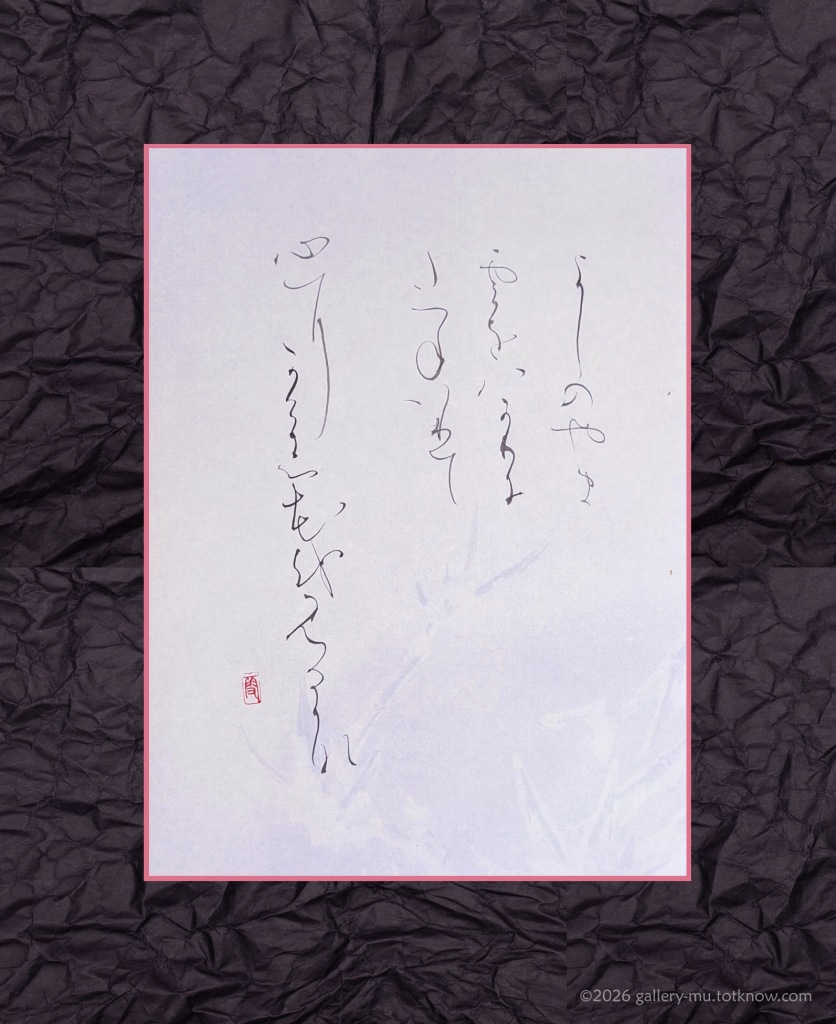
| Size: | about 33×24 cm |
|---|---|
| Dressing: | framed |
What kind of verse?
| verse: | Yoshino yama, kumo wo hakari ni, tadune iri te, kokoro ni kake shi, hana wo miru kana |
|---|---|
| (imho): | When I make my way to Mount Yoshino relying on the clouds, it is there that I see the flowers I have cherished in my heart. |
| poet: | Saigyo |
| in: | 12th century |
The Same Poem, a Different Season
This is the second time I’ve written this waka by Saigyō.
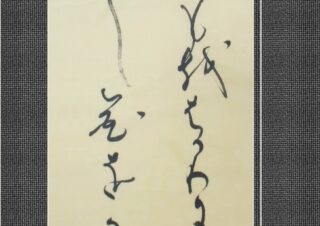
The first version was written in large characters on a long, narrow sheet of paper. In that piece, I tried to express the feeling of entering deep into the misty hills of Yoshino and finally encountering the cherry blossoms Saigyō had carried in his mind.
This time, I approached the same poem from a very different angle.
I chose a smaller sheet and wrote the characters much more compactly. The paper is printed with a pattern of snow‑laden bamboo leaves, reflecting the coldness of the season.
Instead of presenting cherry blossoms in the midst of spring, this piece invites the viewer to imagine them while spring still feels distant.
That shift in mood gives the poem an entirely new expression.
Whereas Saigyō once seemed to move through an outer landscape, in this version his presence feels like a quiet inward journey. The small characters hold a sense of longing for blossoms not yet seen, resting gently in the depths of the heart.
Even with the same poem, the choice of paper, the size of the characters, and the season in which it is written can completely change the way it is experienced. It’s fascinating how such subtle shifts transform not only the physical form but also the emotional landscape of the work.
