#255 Kana Calligraphy on a Waka by Ki no Tsurayuki
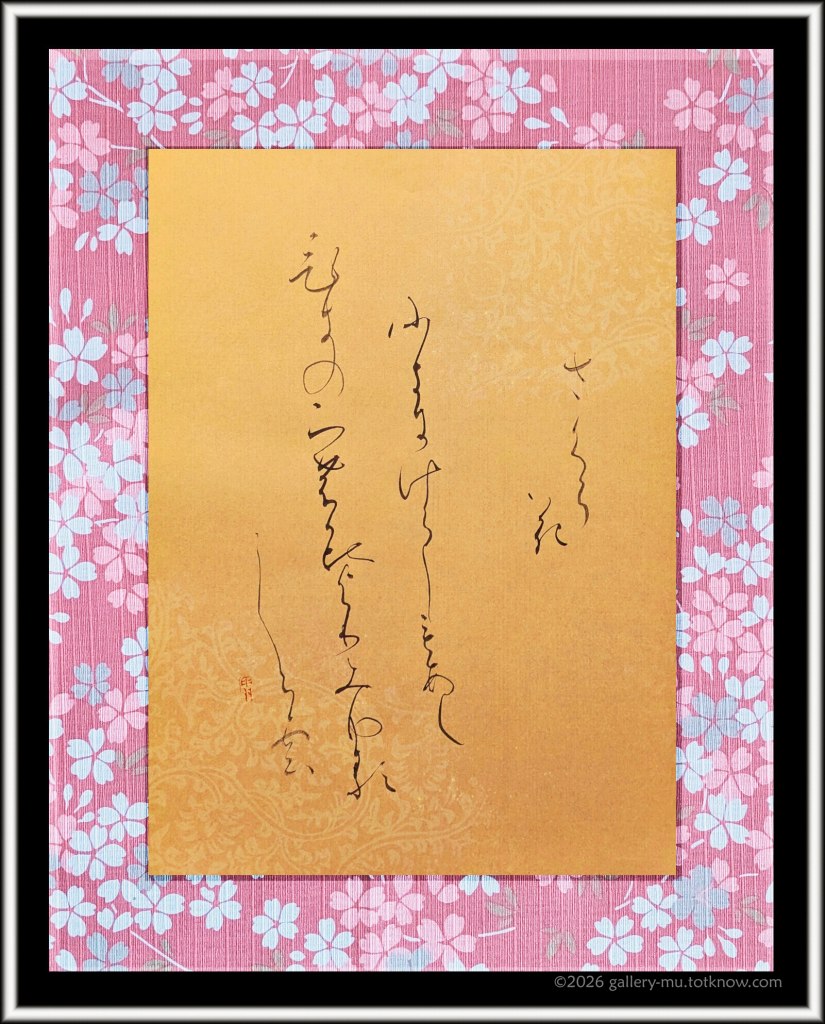
| Size: | about 33×24 cm |
|---|---|
| Format: | framed |
About this Japanese Poetry
| Waka: | Sakura bana, saki ni kerashi mo, ashibiki no, yama no kahi yori, miyuru shirakumo |
|---|---|
| Poet: | Ki no Tsurayuki |
| In: | before 10th century |
A humble reading of the poem:
The cherry blossoms seem to have bloomed—
White clouds can be seen rising
From the mountain valleys.
Changing Perceptions
Even when we use the same word—sakura, cherry blossoms—the colors and scenery we imagine can differ depending on the era and the place.
In classical waka poetry, cherry blossoms were often likened to white clouds.
Seen from afar, mountain cherry trees do not appear as individual blossoms. Instead, they form soft, pale clusters that drift across the mountainside like clouds.
For us today, it may feel a little surprising to imagine cherry blossoms as white. Yet in the Heian period, about 1,000 years ago, the word sakura referred mainly to wild mountain cherries, whose petals were almost entirely white.
Recently, I saw the Kawazu cherry trees in Atami. Their blossoms are a vivid pink—quite different from the mountain cherries of earlier times.
Even when writing the same poem, the expression can subtly change depending on the season, the mood, and the landscape before us.
Compared with the previous work in which I wrote this same waka, this new piece naturally took on a slightly different character.