
#246 On this bright winter’s day,…
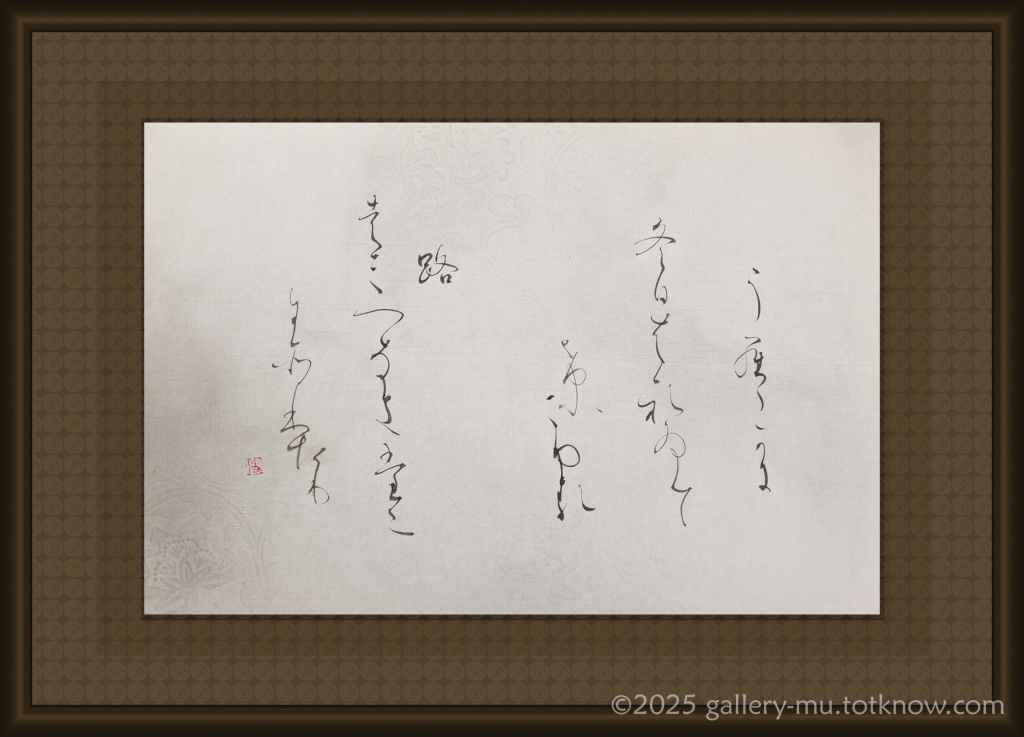
| Size: | approx. 37×25 cm |
|---|---|
| Dressing: | framed |
About this Waka (Poem)
| verse: | Uraraka ni, fuyuhi hare wite, kefu koyu ru, michi ha midu naki, tani ni sohi tari |
|---|---|
| a humble interpretation: | On this bright winter’s day, the road I cross today runs along a valley where no water flows. |
| poet: | Wakayama, Bokusui |
| in: | 1924 |
Idle Thoughts
In 1924, Japan still carried the echoes of Taishō democracy while facing the aftermath of the Great Kantō Earthquake just a year before. People were searching for recovery and new ways of life.
The gentle light of a winter day can be read as a symbol of hope for a society burdened with post-disaster anxiety. At the same time, the dry valley suggests both the severity and the quiet stillness of nature.
Seen against the backdrop of 1924, this poem is more than a simple nature verse. It reflects a “journey of the heart,” shaped by the tension between uncertainty and hope in its time.
