
#259 Notes from a Classical Copy Study
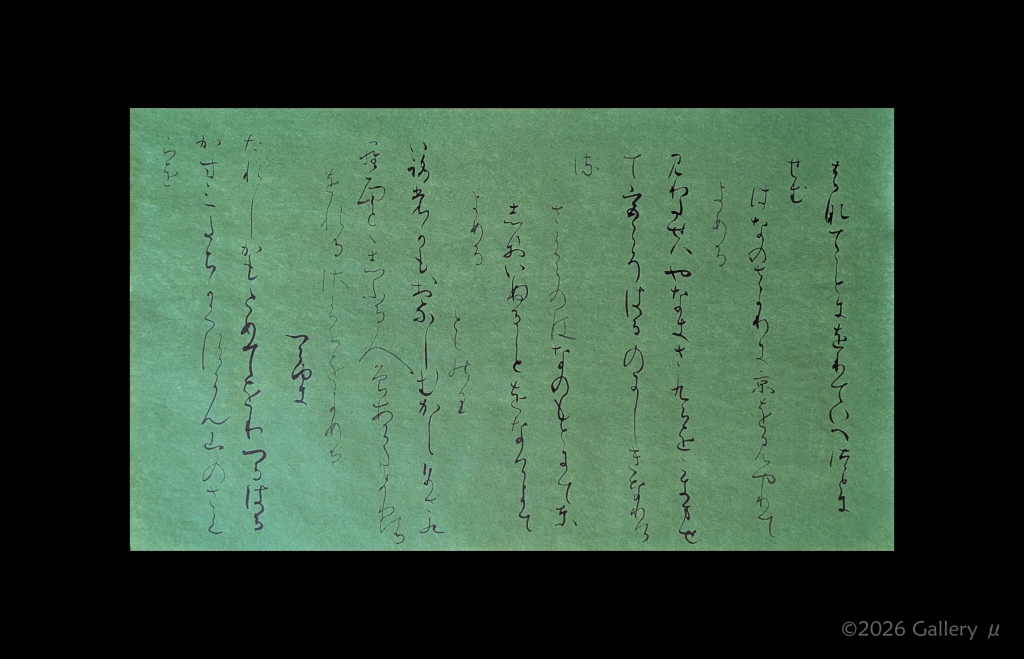
| Size: | approx. 21 × 32 cm |
|---|---|
| Mounting: | framed |
What is the Sekidobon Kokin Wakashū?
Sekidobon Kokin Wakashū is an old manuscript fragment of the Kokin Wakashū, traditionally attributed to the mid-Heian-period calligrapher Fujiwara no Yukinari.
Main characteristics (commonly accepted views)
- Attributed to: Fujiwara no Yukinari (traditional attribution; authorship remains uncertain)
- Date: believed to have been produced in the late 11th century, somewhat later than Yukinari himself
- Content: partial manuscript of the imperial waka anthology Kokin Wakashū
- Collections: held by institutions including the Tokugawa Art Museum, The Gotoh Museum, and Tokyo National Museum
- Cultural status: designated Important Cultural Property and related classifications
Significance in the history of calligraphy
The Sekidobon Kokin Wakashū is regarded as an important example preserving the kana style associated with Fujiwara no Yukinari, one of the “Sanseki” masters of Japanese calligraphy.
Its varied line thickness, rounded brush movement, and rich tonal changes in ink had a major influence on the later development of kana calligraphy.
About This Work
For this study piece, I copied a two-page spread based on a facsimile edition of the Sekidobon Kokin Wakashū.
Dark green dyed paper was used for the work.
The Sekidobon is considered one of the important reference materials for studying mid-Heian kana calligraphy. In classical copy practice, observation extends beyond character shapes to include connected brushwork, spacing between lines, brush speed, pressure changes, use of negative space, and the composition of the page as a whole.
During this work, I examined these characteristics of the original manuscript while proceeding with the copy. I hope to continue incorporating insights gained from classical materials into future calligraphy works.
Ink holds the seasons long after they have passed.
