
#255 Kana Calligraphy on a Waka by Fujiwara no Teika
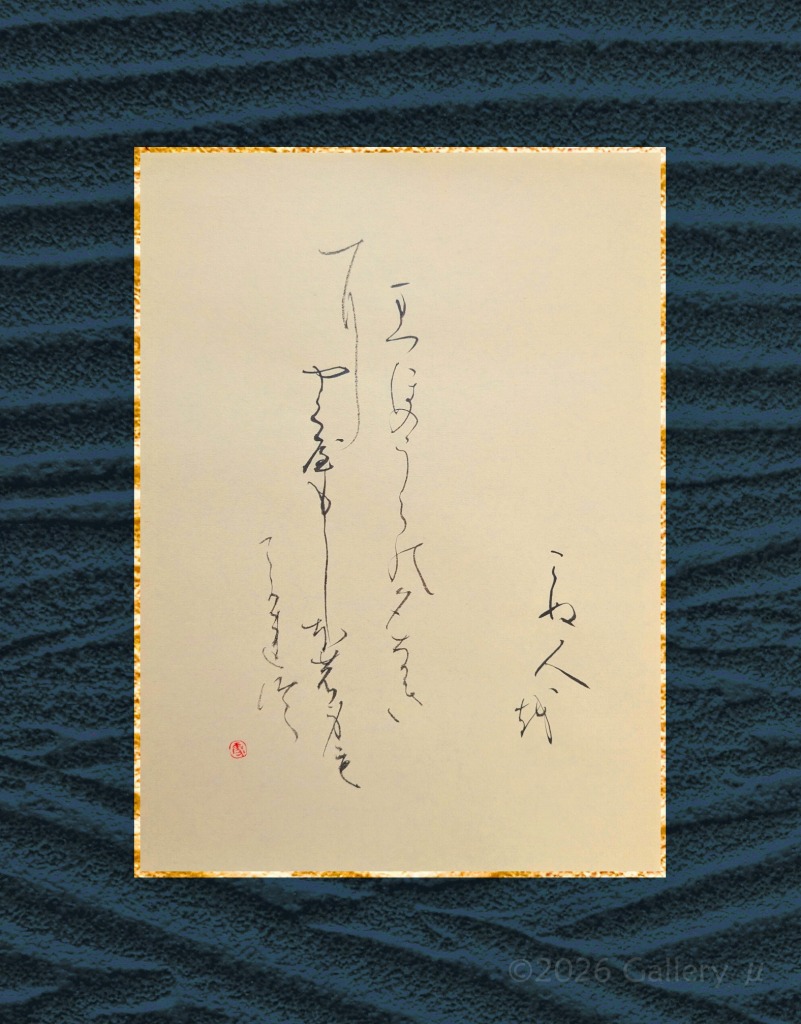
| Size: | approx. 33 × 24 cm |
|---|---|
| Format: | Framed |
The Poem
| Waka/Haiku: | Konu hito o, Matsuho no ura no, Yūnagi ni, Yaku ya moshio no, Mi mo kogaretsutsu |
|---|---|
| Poet: | Fujiwara, Teika |
| In: | 1216 |
A humble reading of the poem:
Waiting for someone who never comes,
I burn with longing,
like the moshio salt
being made at Matsuho Bay
in the calm of the evening sea.
This is a waka, a traditional Japanese poem of 31 syllables arranged in five lines of 5–7–5–7–7.
The poet, Fujiwara no Teika (1162–1241), was one of the most important poets and literary figures of the late Heian and early Kamakura periods. He was 55 when he composed this poem in 1216. The poem was later included in the Shin Chokusenshū, an imperial anthology of waka.
The poem is also one of the 100 poems in the Ogura Hyakunin Isshu, an anthology of one waka by each of 100 poets, compiled by Teika in the early 13th century.
For many people in Japan, Hyakunin Isshu is also familiar as a karuta card game. The 100 poems are divided between cards, and players compete to find the card containing the ending lines of a poem as soon as its opening lines are read aloud.
What is Moshio?
Moshio was salt traditionally made from seaweed. Seawater was repeatedly applied to the seaweed and allowed to dry, concentrating the salt. The seaweed was then burned, and the resulting material was further processed to extract the salt.
Teika uses this laborious process as an image for longing. Just as the moshio is exposed to fire, the speaker is consumed by love for someone who does not come.
Although Teika himself was a man, the poem speaks in the voice of someone waiting for a beloved who never arrives. Its emotional intensity has made it one of the best-known poems in the Hyakunin Isshu.
A Personal Note
At my junior high school, the winter season brought an annual Hyakunin Isshu karuta tournament.
The entire grade gathered in the gymnasium and formed teams of five or six students. We competed in a tournament, turning these classical poems into a lively school event.
It was through this game that I first became familiar with the Hyakunin Isshu. By my second year of junior high school, I had memorized all 100 poems.
At the time, I never imagined that these poems, which I knew simply as part of a card game, would eventually become something I would engage with professionally through kana calligraphy.
The poems I learned as a student, and the sounds and images carried within their words, have remained with me through the years. Today, they have become an important part of my work as a kana calligraphy artist.
In that sense, the Hyakunin Isshu I encountered as a student has become one of the starting points of my journey as a calligrapher.
Materials & Presentation
Materials: Kana calligraphy paper and hand-ground sumi ink
The delicate texture of the paper and the depth of the ink create a quiet sense of depth.
Presentation: Custom-mounted and presented in a high-quality acrylic frame
Each work is carefully prepared to suit the character of the calligraphy and to harmonize with contemporary interiors. The result is a refined presence that settles naturally into the surrounding space.

(AI-generated image)
Ink holds the seasons long after they have passed.
