
Copying a great work of calligraphy from a classical model is an essential part of learning calligraphy.
But it is not simply about reproducing the shapes of the characters.
When studying an old rubbing, the carved lines provide clues to the movement of the brush behind them. By imagining that movement and tracing it with my own brush, I find something almost like solving a puzzle.
There are many things to observe: the thickness and speed of the lines, changes of direction, the amount of ink held by the brush, and the spaces between characters.
For me, the pleasure of studying a classical work lies in gradually uncovering these details.
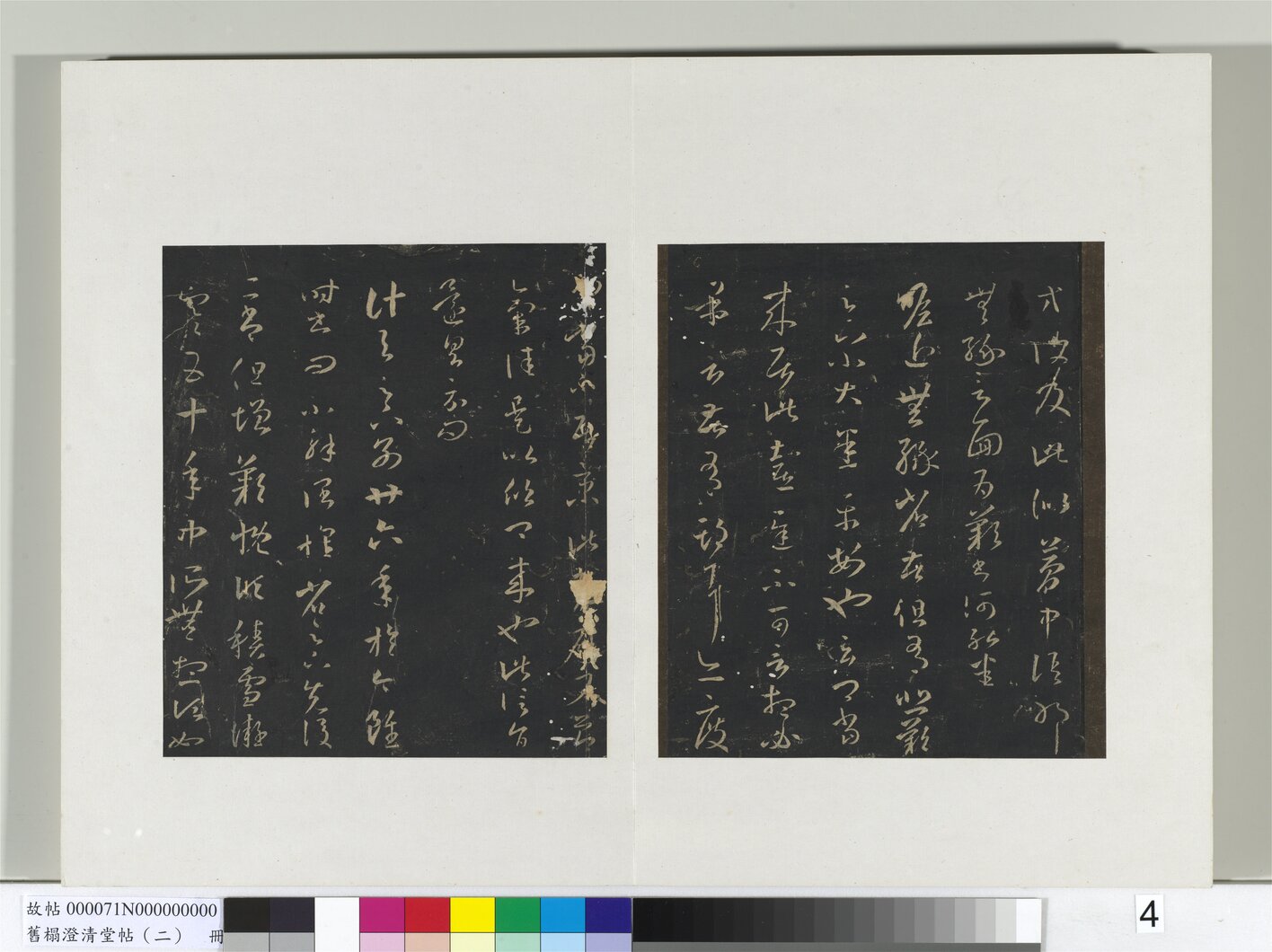
For this study of Wang Xizhi’s Seventeen Letters, I used the Song Rubbing of Chengqing Tang Tie (Chengqing Tang Tie, 澄清堂帖), preserved at the Palace Museum in Beijing, as my principal model.
Encountering Chengqing Tang Tie
Chengqing Tang Tie is a famous model-calligraphy album containing engraved versions of works attributed to Wang Xizhi (303–361), the celebrated calligrapher of the Eastern Jin dynasty.
The original engraved stones have been lost, so today we can study these works through surviving rubbings.
The exact history of its production is not fully known. The Palace Museum notes that the date of the engraving and the names of the craftsmen are not recorded, and that the original structure of the complete work is uncertain. Surviving Song-dynasty rubbings are therefore particularly valuable.
The edition I studied is the Song Rubbing of Chengqing Tang Tie, in the collection of the Palace Museum in Beijing.
Each leaf measures approximately 26.3 × 26.9 cm.
What first caught my attention was the clarity of the carved lines.
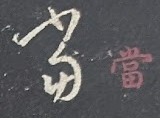
Because the boundaries of the lines are so clearly defined, they provide a useful starting point for imagining how the brush may have moved across the original paper.
Wang Xizhi’s Seventeen Letters
Seventeen Letters (Shiqi Tie, 十七帖) is one of the most important classical models of cursive script associated with Wang Xizhi.
It is a collection of letters, preserved not as Wang’s original manuscripts but through engraved and rubbed versions transmitted over the centuries.
For anyone studying Chinese calligraphy, Seventeen Letters is an essential work to encounter.
My renewed study of this classic began when a calligrapher kindly lent me a reproduction of the Song Rubbing of Chengqing Tang Tie, formerly in the collection of Xing Dong.
 宋拓澄清堂帖(邢侗旧蔵本)
  作者: 故宮博物院編
  出版社:紫禁城出版社
I first spent about six months copying the entire text on Japanese hanshi practice paper, working six characters at a time.
This extended study helped me become familiar with the distinctive characteristics of Wang Xizhi’s cursive script and, more importantly, with its underlying rhythm and logic.
Learning on Practice Paper, Then Working at Full Size
When I first studied Seventeen Letters on hanshi, I paid some attention to the brush I used, but simply used the paper I normally use for practicing Chinese characters.
Working at full size changed the situation considerably.
At full size, each character has to be examined more closely. The level of visual attention needs to be raised.
It is also no longer enough to focus on individual characters. I had to consider the size of each character, the extension of the lines, the distances between characters, the spaces between lines, and the overall balance of the page.
Paper and brush—things I had previously taken for granted—now had to be reconsidered.
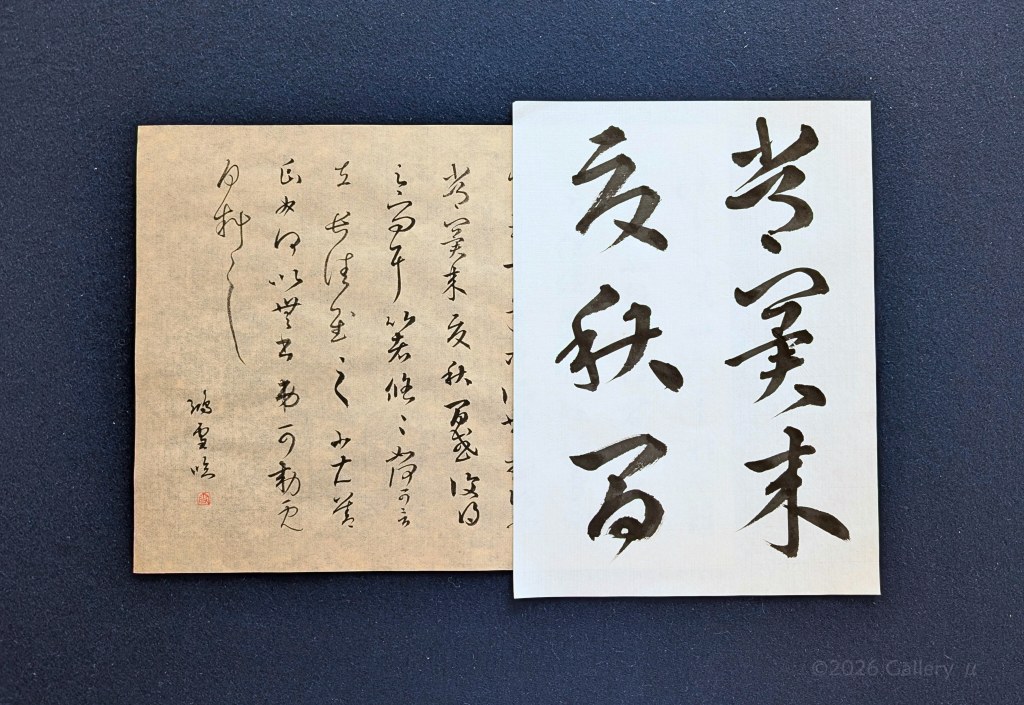
Finding the Right Paper for a Full-Size Study
The first thing I explored was paper.
Ordinary hanshi paper for Chinese-character practice absorbs ink too readily. With a small brush, the ink can run out before a line is complete.
So I tested several types of paper, looking for the one that produced the quality of line I was seeking.
| Paper | Character | Ink behavior | Result |
| Mashi | A texture reminiscent of ancient paper | 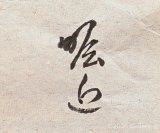 | Absorbed too much ink |
| Shinryōshi | Dyed paper traditionally used for kana calligraphy | 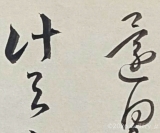 | Clear lines, but difficult to produce dry-brush effects |
| Sattaishi | Japanese paper traditionally used for bundling banknotes | 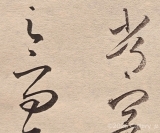 | Both wet and dry brush effects appeared readily |
| Kozo paper | Japanese paper made primarily from kōzo fibers | 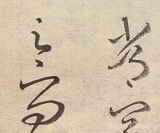 | Best balance of wet brush, dry brush, and brush texture |
Points I evaluated
- How the ink entered the paper
- How clearly the line emerged
- The balance between bleeding and dry-brush effects
- The texture of the brushstroke
In the end, I chose kōzo paper for this full-size study.
Choosing the Brush
Next came the brush.
By examining the lines in the original model, I tried to imagine what kind of brush might produce them and tested several brushes.
- Elasticity of the brush
- How well the tip came together
- How much ink it could hold
- How naturally the line tapered as it became thinner
I ultimately chose a small Kolinsky-hair brush whose tip had been slightly worn through use.
Rather than a new brush with a sharp, precise tip, this slightly worn brush made it easier to reproduce the subtle splitting of the brush line that appears in places in the original.


Discovering Differences Through the Mitsui Version
Several engraved versions of Seventeen Letters are known. Among them is the Mitsui version, or Mitsui-bon.
After studying Chengqing Tang Tie, I experienced an unexpected sense of difference when I began copying the Mitsui version.
The differences were not limited to the structure of individual characters.
- the space between characters
- the space between lines
- the size of individual characters
- the amount of space occupied by each character
In other words, the ma—the space itself—felt different.
In some places, the changes of direction in the Mitsui version appear to be expressed in two stages. When I returned to Chengqing Tang Tie, I did not feel the same sense of discontinuity in corresponding passages.
Comparing the two versions gave me a more concrete way to imagine the intentions behind Wang Xizhi’s brushwork.
I also placed the Ueno version alongside them. Even though all three transmit the same classical text, each version reveals different qualities in its lines, movement, and spacing.

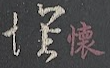

Reading the Ma — The Space Between
The most fascinating part of this study was not the individual characters, but the ma—the space between them.
When writing six characters on a sheet of hanshi, it is easy to concentrate on the structure and brush technique of each individual character.
At full size, however, a character does not exist in isolation.
Write one character
→ move to the next
→ continue to the next line
As Wang Xizhi wrote, his thoughts were likely with the person he was writing to and the matters he wished to share. The spacing was not necessarily something he consciously planned. Rather, it emerged naturally from the flow of writing, shaped by years of experience and a mastery of the brush.
In the characters and the spaces between them, we may glimpse the sensibility he had cultivated over a lifetime.
Reading Brushwork in Carved Lines
What remains in a rubbing is a carved line.
From that line, I try to imagine how the brush once moved.
Then, by testing that movement with my own brush, I can experience something of the brushwork that lies behind the carved line.
After spending about six months studying Seventeen Letters on hanshi, working at full size allowed me to notice things I had previously overlooked: the paper, the brush, the character of the line, and the spaces between them.
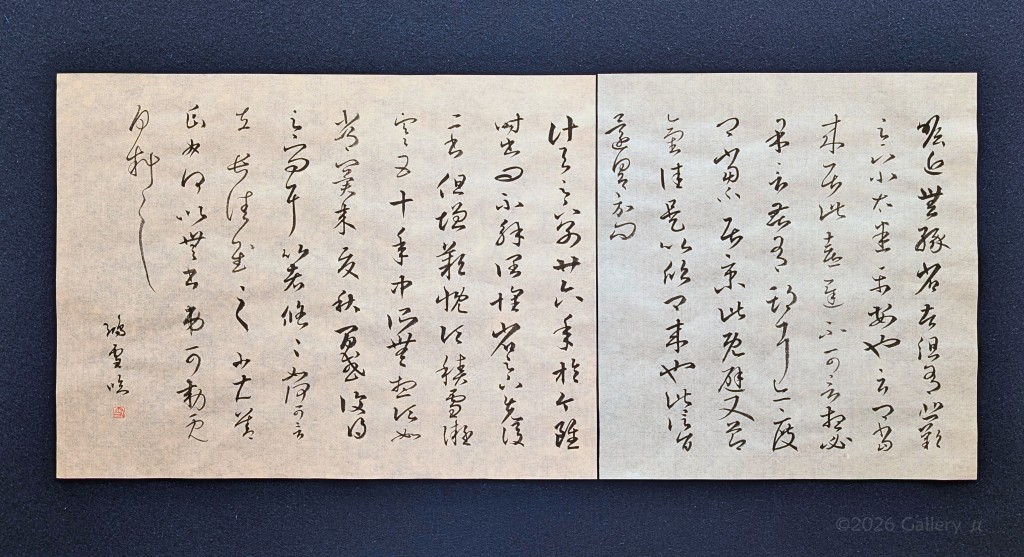


This study of classical calligraphy will continue.
By following the lines of these old works, I hope to carry what I have discovered into my own calligraphy.
Acknowledgements
Reference Materials
- Palace Museum, Beijing, Song Rubbing of Chengqing Tang Tie (宋拓澄清堂帖册).
- Palace Museum, ed., Song Rubbing of Chengqing Tang Tie: Formerly in the Collection of Xing Dong, Beijing: Forbidden City Press, 2010.
- National Palace Museum, Taipei, “Old Rubbing of Chengqing Tang Tie (II): Wang Xizhi.”
- Cultural Heritage Online, Agency for Cultural Affairs, Japan.
- Kyoto National Museum, collection information on classical Chinese calligraphy.
Acknowledgements
My sincere thanks to the calligrapher who generously lent me the valuable reproduction of the Song Rubbing of Chengqing Tang Tie (formerly in the collection of Xing Dong).
